THIS IS THE TEXT OF A BOOK WHICH GIVES A DIFFERENT TOUR OF THE CATHEDRAL.
SPACING OF THE LINES AND PARAGRAPHS GOES TO BLAZES ON TRANSFER FROM ONE SITE TO ANOTHER. SORRY, I'M TRYING TO WORK IT OUT.
APOCRYPHAL
TALES OF
DURHAM CATHEDRAL
J. W. DICKENSON
1st Edition 1988
2nd Revised Edition 1990
© J. W. Dickenson
INTRODUCTION
|
After the third or fourth visit to Durham Cathedral, when the awe inspired by its beauty, size and grandeur has worn off sufficiently for an appraisal to be made, the ordinary person tends to look for curiosities, legends and unique facts to do with the cathedral. This self defence mechanism works even more swiftly if one has been bombarded with dates, names and architectural details given in a conducted tour by a conscientious guide. If such unimportant and blasphemous items contained in this booklet are considered unworthy of such an impressive building and its contents, it must be pointed out even the builders of the cathedral enjoyed a joke look at the corbels under the vaulting and discover the odd face amongst those cat-faces is a face that is said to be a copy of the master builder of that time. Here are some unusual stories and legends of the cathedral, the truth of which cannot be totally vouched for. |
APOCRYPHAL TALES OF DURHAM CATHEDRAL CONTENTS
(a) Roll up, Roll up.
(a) Whose Cathedral is it?
(a) Night Watchman.
(a) Change of Usage.
(b) Where is the Count?
(c) Sanctuary Bell,
(c) Bede! Stolen or strayed?
(d) St. Cuthbert-Misogynist.
(e) Early prefabricated buildings.
(f) Bishop Skirlaw's poor.
(g) Graffiti 1700 Style.
(h) Misericords.
(h) Hatfield.
(h) Where was Hatfield.
(i) Exotic Animals.
(i) Dead Wrong 'un.
(j) Changing window designs
(j) Choir-boy's Head.
(j) Flamboyant Bek.
(k) Self Advertisement,
(1) Carve Up.
(m) 'anglng on an 'ook.
(m) Will the real St. Cuthbert please stand up?
(n) Leaning pillar and Mistake.
(o) Cathedral Bakehouse,
(o) The Curfew shall not ring tonight.
(p) Washington and the USA.
(q) Summer and Winter Solstice,
(r) Coats of Arms.
(s) Charlies.
(t) The 'Whale' truth and nothing but the truth.
(u) Mutilated Manuscripts.
(v) Monks' Dungeon.
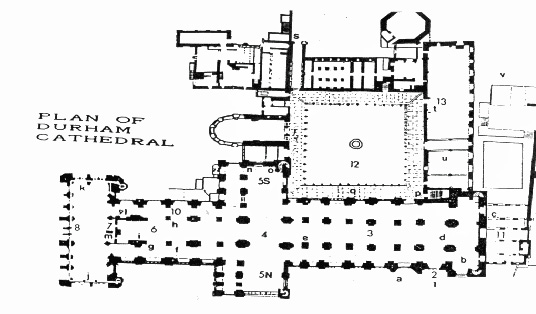
[Letters in brackets indicate position in the Cathedral of the stories. See Plan at the head of the story.
ROLL-UP, ROLL-UP (a)
Outside the North door of the cathedral is a battered tombstone with a carved figure which looks as if it is holding a purse. This is the tomb of a tight-rope walker who fell to his death whilst performing on a rope stretched between the western tower of the north transept and one of the west towers,
In 1237 Prior Melsonby was of the opinion that the monks needed some entertainment and arranged this little distraction for them. Unfortunately it turned out to be anything but entertaining for them and for himself. King Henry the Third, hearing of the event and the result forbade the consecration of Prior Melsonby as Bishop. His objection was that the Prior should not have given his consent to the enterprise, and indeed should have vetoed it. The King, it must be pointed out, had his own favorite in line to be Bishop and his other objections to the Prior were, to say the least, lies. According to local legend, if the tomb of the tight rope walker is observed in the rain silver coins are visible on the stone.
WHOSE CATHEDRAL IS IT?
(a)
An oft-told tale about the cathedral is the story of the Dissolution. The Prior of the Convent of Durham at the time was Hugh Whitehead who on the 12th May 1154 became the first Dean of Durham. He realised the uselessness of offering any resistance, and bargained for what he could save of the old ways. For what it was worth, he managed to abstract a promise from Henry VIII to the effect that should the new religion fail to treat the cathedral with respect and see to its repair, it would automatically be returned to the Catholic Church. People seeing scaffolding permanently against the walls and towers of the cathedral are satisfied that the bargain is being kept
NIGHT WATCHMEN
(a)
The Sanctuary Knocker on the North Door was not the only visible help given to a fugitives from the law, From a position inside the Cathedral between the two pillars of the Nave, look above the North Door and you will see two built-in arched windows. In a room containing these windows, reached by a staircase leading from the North Aisle, two monks were on duty night and day awaiting the banging of the Sanctuary Knocker, and should this happen the watchers would open the North Door to the person demanding sanctuary. This action set in motion a series of events leading, in most cases, to voluntary transportation of the fugitive overseas. To return meant death, as a person outside the law could be hunted and killed by any law abiding citizen.
CHANGE OF USAGE.
(a)
William Wittingham, 6th Dean of Durham in 1563 could be said to have destroyed some of the greatest treasures of the Cathedral but it must be pointed out, he was ably assisted by his wife. When facing the North Door the square plinth of the pillar of the North Aisle to the left can be seen to have a chunk missing. The same can be said of the pillar opposite the Priors door in the South Aisle. Attached to these plinths were Holy Stones. These were ornately carved marble basins containing holy water for use by the worshippers and monks. Mrs. Katherine Wittlngham, a French woman, had them taken to her kitchen and used as salt fish and salt beef containers. She also had the marble covers from the graves of monks used to pave her kitchen. Her greatest crime, however, was the burning of the banner of St. Cuthbert the rallying sign of the “The Haliwerfolk”, the people of Durham.
WHERE IS THE COUNT?
(b)
Count Joseph Boruwlaski, a native of Poland, measured no more than three feet three inches in height. He first arrived in Durham in 1782 and entered Durham society, being a musician, intellectual and conversationalist. He stayed with the Misses Ebdon in a cottage in South Bailey. The old ruin on the river banks, known as the “Count’s House”, was in fact a summer house. The Count’s belongings are on display in the Town Hall. He died in 1837 at the age of 98 and a black marble tablet on the wall of St.Mary-the-Less situated in South Bailey clearly states that “near this spot repose the remains of Count Joseph Boruwlaski” This could be accepted as fact were it not for a small, simple slab marked ‘JB.’ in the floor beneath the north~western tower of the cathedral in front of the Services Commemorative Window. The term ‘near’ could mean the church next door.
SANCTUARY BELL.
(c)
In the roof of the alcove of the East Window of the Galilee Chapel on the right is a hollow where the Galilee Bell was situated. This bell had a special function. When a person banged the ring on the Sanctuary Knocker he was admitted by the watchers from the room above the North Door. One monk escorted the person to the enclosed alcove under the South West Tower. The other monk went to the Galilee Chapel and rang the Galilee Bell. This informed the town that a man was asking for sanctuary. It also informed the Prior, Sacrist and Coroner that they were to attend the Cathedral. When they arrived the man was taken to St. Cuthbert’s Shrine where he confessed his crime and afterwards swore the oath of obduration, was stripped of his clothes (which were given to the Sacrist as a gift to the Cathedral) and donned a black gown with a large yellow cross of St. Cuthbert on the left shoulder.
BEDE - STOLEN OR STRAYED
( c)
About the year 1022 a monk of Durham, Aelfred, a relic hunter of the most exploitative type, carried off the bones of Bede from Jarrow. Not only did Jarrow suffer this indignity but so did all the ancient monasteries of Northumbria He brought to Durham a portion of the relics of two anchorites, two Bishop; one King, two Abbesses and one Saint. Not a bad haul. With Bede, all were placed next to the body of St. Cuthbert. In 1370 Bede was moved to the Galilee Chapel and placed in a special tomb. The monk given the task of cutting the epitaph for the new cover of Bede’s Tomb wondered how to find a suitable epithet to describe Bede. He fell asleep whilst considering this problem and was visited by an Angel who cut the missing epithet, ‘VENERABILIS’?. He has been known as the Venerable Bede ever since.
ST. CUTHBERT-MISOGYNIST
(d)
St. Cuthbert was supposed to hate women, hence the reason for the black marble paving at the west end of the Cathedral beyond which, in medieval times, women were not allowed. Some tried.
When King David of Scotland and Queen Margaret visited Durham, the Queen’s Lady-in-Waiting, Helisand, disguised herself as a monk and tried to make an offering at the Shrine of St Cuthbert. She was discovered by the intervention of the Saint himself and was forced to become a nun in Elstow nunnery in Bedfordshire,
Two women from Newcastle, dressed as men, tried to reach the Shrine. They were found out by what means is not known and forced to do penance in public at two churches,
In 1333 when Edward III and Queen Philippa visited Durham they were lodged with the Prior. When it was pointed out that Queen Philippa was in the restricted area she had to make a detour, in the middle of the night, around the monastery, quite a distance, to be lodged in the Castle. The influence of the dead saint was considerable. He may one day share the High Altar with a female Bishop
EARLY PREFABRICATED BUILDINGS
(e)
The ‘Pre-Fabs’ after the Second World War were considered to be temporary buildings built to last ten years. Some lasted nearly thirty years. This should not have come as any surprise to anyone living in Durham. The massive pillars in Durham Cathedral Nave were an early example of prefabrication. The stones of these pillars were cut as blocks and carted to the Cathedral to be put into place, and the centre of the pillars filled with rubble. The composition of this rubble would be interesting to analyse. The patterns are such that, whilst complicated to the observer, are simple in the extreme. The ‘diamond’ design is made up of one only pattern per stone. When each stone is placed half-way between two other stones, the pattern is complete. The ‘chevron’ design is more complicated because there are two patterns. There are two diagonal cut stones which fit the stone with a ‘V’ cut into the top centre. Inspection of these pillars will show how the simplicity of the design can create an impressive pillar of stone. The circumference of each pillar is equal to its height. If doubts assail you, count the ‘diamonds’.
BISHOP SKIRLAW’S POOR
(f)
Most Bishops arranged to have an elaborate Mass said every year in the cathedral to commemorate their deaths. This was expensive, and, as time went on, the Mass was merged with other feast days and sometimes lost altogether. Bishop Skirlaw was a charitable man and the idea of one expensive Mass in which none of the poor benefited distressed him but he wished to have a Mass said for him in accordance with the prescribed method for the reduction of purgatory. He had the position of his tomb designated and had eleven seats, which are still there, built into the wall on the South Aisle of the Choir opposite his tomb with twelve Skirlaw coats of arms carved underneath. One of these seats was made to accommodate a very thin man. He arranged for eleven poor men of the town to come and sit on his seats and say a prayer for his soul each day, for which they would receive payment of a small amount of money.
GRAFFITI 1700 STYLE
(g)
It Is always thought that vandalism is a modern occupation of youth. Take a look on the wooden screen on the north side of the choir and you will see carvings done by choirboys of yesteryear. It consists of names, dates and initials and the years between 1733 to 1749 seem to be when the greatest number were carved. Some names: Thomas Heslop, Ralph Banks. Middleton and Wales, all good Durham names, especially Thomas Heslop. Could he be related to Thomas Heslop, the butcher of Durham, whose daughter married John Duck? One name is Intriguing T. Ebdon occurs twice, once in 1733. A T, Ebdon was a composer and Cathedral organist at one time and the Misses Ebdon, family of Thomas Ebdon, befriended Count Boruwlaski, the Polish dwarf, in 1800 Could young Thomas Ebdon as a choir boy in 1733 have become organist in the Cathedral? What fame the other carvers attained is not known but at least some of their carvings have achieved recognition. Give a boy a knife and he immediately proceeds to make his mark for posterity.
MISERICORDS
(h)
In the choir stalls there are hinged seats which, on the undersides, show what is known as a misericord, the definition of which is ‘serving when seat was turned up to support person standing’, These were used by the monks during the long and frequent services of the Benedictine Order and enabled them to snooze whilst ostensibly listening with closed-eyed concentration to the sermons, These misericords are finely carved, and show a huge crab, a barking dog, a man sucking his fingers, a monkey eating a nut a dolphin, two men with a fish, a dragon, a squirrel eating nuts, and a lion chasing a man. To inspect these a cathedral official should be contacted.
HATFIELD
(h)
Hatfield, one of the more flamboyant Bishops of Durham, has a number of stories attributed to him.
Upon his becoming Bishop he was informed that he was entitled to a coat of arms in keeping with his status as Prince Bishop. After some discussion as to the form it should take, he pointed to the coat of arms of the See, (the same as the County of Durham) a gold cross with four silver lions on a blue background. He was politely told that he was not able to claim the coat of arms of the See as his own. He loftily suggested that the See should have a new coat of arms whilst he took over the original. After much debate he agreed to a compromise. He opted for a coat of arms as near to that of the See, a chevron of gold with three silver lions on a blue background.
Hatfield was a vain man in some respects and when he discovered that the throne of the Pope was raised above the congregation some few steps he immediately had his throne (the cathedra) placed on a platform about ten feet from the ground with fourteen steps leading to it. It is the highest in Christendom. He also arranged to have his tomb situated immediately below the cathedra and was heard to say, when discussing the tomb and his death,” Whoever gets this job after me will get it over my dead body.”
WHERE WAS HATFIELD
(h)
The ornate tomb of Hatfield holds some surprises. For instance, he made sure that his coat of arms figured prominently on it The coats of arms which cover the front and rear of the tomb are supposed to be a pictorial list of the earls and knights who accompanied King Edward III to France and fought in the Battle of Crecy. When he discovered that there were fewer coats of arms than places Hot field ordered his own to fill the vacancies.
Facing the front of the tomb, to the right, can be seen the coat of arms of King Edward III and as proof of Hatfield's friendship with the king he was allowed to attach a a small bust of the sovereign next to it. According to some historians Hat field was said to have fought at the battle of Neville's Cross in 1346 with the Archbishop of York, the bishops of Lincoln and Carlisle, Others hasten to state that he could not have been present at this battle as he was leading eighty archers to the siege of Calais and subsequently at the battle of Crecy. Where was he?
EXOTIC ANIMALS
( i )
High up above the High Altar are some strange animals with wings. Strange in the sense that, in the case of one of them, it is hard to understand how it could have been known to the sculptor of the time. The animals in question can be seen on the top of the Early English pillar on the left front of the High Altar. They are a lion with wings and a rhinoceros with wings. Where would a 13th century sculptor in England see an original rhinoceros, or, for that matter, a drawing of one? Central Africa, home of the rhinoceros, had not been discovered. Perhaps one had been caught or seen but for that knowledge to reach Durham is doubtful. A lion with wings seems possible, but a rhinoceros, with or without wings, is stretching the imagination of the medieval carver to the limit.
DEAD WRONG UN.
(i)
In front of the High Altar steps a carpet stretches nearly to Hatfield’s Tomb, Under it is the tomb of Bishop Louis de Beaumont 1318-1333. It has a huge brass on it with the outline of the bishop in his robes and regalia. If you are able to view this magnificent brass you will immediately assume that this can only be the tomb of en outstanding bishop, equal to any before or after. You would be wrong. His was a political appointment (his brother was in charge of Edward 2nd ’s army) and not a very good one, for Durham.
On his way to take possession of the see, against the advice of the Prior of Durham, accompanied by two cardinals, he came north without an escort. He was met at Rushyford, near Ferryhill, by a band of marauding rebels from Northumberland. They plundered and dismissed the cardinals but the bishop and his brother they took prisoners demanding a heavy ransom which the monastery paid. Bishop Beaumont was extremely ignorant and during his consecration ceremony when he had to repeat words in Latin he became enraged and said in French,” Take it as said.”? He was forever demanding money from the monastery and indeed everyone in the Palatinate.
CHOIR-BOY HEAD
( j )
It was in the sixteenth century that the choir master of Durham Cathedral had a deformity of his legs and found great difficulty in walking. During the processions he found one of the choir-boys imitating his walk. Upon catching the boy repeating his mimicry during the procession through the Chapel of the Nine Altars he issued a solemn warning that if the boy was caught again miming the choirmaster his head would adorn the wall of the Chapel of the Nine Altars. Sad to say he was caught repeating his actions the very next day. If you regard the carved heads arranged in line on the north wall of the Chapel of the Nine Altars you will see the cherubic head of a choir-boy.
FLAMBOYANT BEK.
( j )
In his life Bishop Bek was the grandest of the Prince Bishops if not the most popular. He quarreled with King Edward I who, on several occasions, seized his possessions. The prior and the monks of the monastery expressed dissatisfaction with Bek and were locked in the church for their pains. Even the people and the barons of the Palatinate had cause to complain. Everything he did was on a grand scale but by the time he died all, or nearly all, was forgiven. Before he died he made arrangements for his body to be buried in the Cathedral but whilst this was agreed during his lifetime the agreement was broken. The argument was to the affect that the only bishop to be buried in the Cathedral was St. Cuthbert and permission for Bek’s body to pass through the church of St. Cuthbert was refused. Some of his supporters ingeniously overcame this problem. They stated that the Chapel of the Nine Altars was not really the main body of the church and if the remains of Bek could somehow be laid to rest in this place all arguments would cease. The answer was simple. A hole was cut into the West wall of the Chapel Wall of the Nine Altars and the coffin of Bek was brought into the Cathedral by this means and laid to rest in front of the hole In the wall.
CHANGING WINDOW DESIGNS
(j)
The large oblong area in which you are now standing houses the Chapel of the nine Altars. Originally it was a Apse end of the cathedral which curved round from one great pillar of the North wall to the corresponding pillar in the South wall and enclosed the perambulatory around St Cuthbert’s ornate tomb. In the 13th C. the Apse was in such a poor state of repair that it was pulled down before it fell down and hurt someone.
The construction of the present walls was begun with the intentions that it should house a Lady Chapel. As the walls grew the wall on the South side, the area proposed for the chapel, fell down. This happened time and time again over some years although the rest of the building work progressed normally.
Then someone reminded the bishop of the tradition that St Cuthbert hated women (see paragraph d) and suggested that perhaps he was responsible for holding back the building work. The proposed site of the Lady Chapel was changed to the Galilee Chapel at the opposite end of the cathedral and the building work progressed unheeded.
However such a length of time had passed that architectural styles had changed. Look up and you will see that the window in the North wall is “decorated” while that in the South wall is “perpendicular”.
SELF ADVERTISEMENT
( k )
The idea of having your picture taken next to some outstanding personal work of achievement is the rule today. A similar method was in vogue in the thirteenth century. The faces of the two stone masons responsible for the beautiful sculptures in, and part of the design of, the Chapel of the Nine Altars, carried out about 1235 AD. are to be found above the wall arcade, to the western side of the two bays or compartments into which it is divided vertically. They must have sat for each other and show each in working habit, their hair protected by dust caps tied under the chin, exactly as shown in contemporary drawings of medieval masons at work, with hair just protruding in a curl in the front and hanging down behind. One of the portraits in stone is of an old man with a scallop-shell pattern in front, sharp-featured, whilst the younger man looks thoughtful. They give the impression of keeping a permanent eye on their work, and eavesdropping on the comments of the pilgrims of old and now the “pilgrims” of today.
CARVE-UP
( l )
Just below the stairs to St Cuthbert’s Tomb, on the south side of the Chapel of the Nine Altars, is a thin granite slab containing the names of the Bishops and Deans of Durham and the dates of their incumbencies It also shows the coats of arms of the Bishops, and, at the top, the coat of arms of the Bishopric. The story often told is of the stone mason, having completed the plaque, and witnessing its being placed in position, being horrified to discover that he had omitted one of the bishops. He had the plaque immediately removed, turned over, and the lists repeated, including the name and dates of the missing Bishop. The officials, however, claim that no such mistake was made, but they would, wouldn’t they? Apart from taking the plaque from the wall, it is impossible to verify this tale unless you ask the stone mason.
‘ANGING ON AN ‘00K
(m)
Directly above the shrine of St. Cuthbert, hiding an ancient pulley, is a canopy depicting the four apostles Matthew, Mark, Luke and John. From this pulley hung the magnificent original medieval cover of the shrine of St. Cuthbert. The rope attached to the cover had six silver bells so that when the cover was raised the whole cathedral knew that St. Cuthbert’s coffin was uncovered for viewing. The cover was gilded all over and on the four sides were painted ‘lively images curious to the beholder'. On the east end was painted a picture of ‘our Saviour sittinge on a rainbowe to geive judgement’, whilst on the west end was a picture of ‘our Lady and our Saviour on her knee’. It also had locks fitted to every corner. In the Galilee Chapel are two other pulleys fixed to the cross—beam of the roof. One is over Bede’s tomb and is said to hold the carved wooden canopy which was suspended over the shrine used in the Corpus Christi processions, but was probably used to suspend a light over St. Bede’s altar. The other pulley can be seen over a recess formerly occupied by the altar of Our Lady of Pity, on the other side of Cardinal Langley’s tomb.
WILL THE REAL ST.CUTHBERT PLEASE STAND UP?
(m)
Perhaps the greatest cathedral oddity of them all is the mystery of the whereabouts of St. Cuthbert’s body. It is alleged that, just before the Commissioners of Henry VIII came to put into effect the Dissolution, the monks exchanged the body of St Cuthbert for the dead body of an ordinary monk. The body of St Cuthbert was then reburied at some unspecified place known only to three monks. These three monks made solemn vows never to divulge the whereabouts of the grave until near death, when they would pass on the information to another member of the Catholic Faith. Numerous places have been suggested, and even one or two locations have been investigated, but to no avail. It could be that the message at some point was not passed on. Will the person, or persons, knowing where St Cuthbert’s body is buried, please step forward?
LEANING PILLAR AND MISTAKE
( n )
It was not often that medieval masons made mistakes but there is a glaring mistake and an optical illusion in one and the same pillar. If you enter the South Transept and face Prior Castell’s clock, the pillar immediately to the left has a chevron pattern. One of the chevrons Just above head height has been cut wrongly. If you return to the clock and look up and down the side of the pillar from certain angles, it seems to lean.
CATHEDRAL BAKEHOUSE.
(o)
There were two fires in Durham Benedictine Monastery. One was in the Common House ( Where the Treasury is now) where the monks were able to get warm after church duties during winter months. The other had more to do with religious beliefs than comfort. At the bottom of the Tower Stairway in the South Transept is a small fireplace known as the Obley. It was used to make the wafers offered in the sung mass (hence the name singing breads) and by the use of ‘Obley irons’ impressed on them some Christian symbol. The rules of the monastery gave the precise details of the conduct of the Sacrist in preparing the bread to be consecrated, Whilst the flour and water was being mixed and the brother holding the irons in which the hosts was being made and baked, the monks involved in the making, recited psalms. Apart from this, complete silence was maintained except for instructions to the servant tending the fire. Clearly this sort of preparation was a display of reverence and appropriate that it should take place in the church itself. It is recorded that in 1545 breads were bought for the cathedral already prepared.
THE CURFEW SHALL NOT RING TONIGHT
(o)
The ringing of the curfew (to inform the towns-people to douse all fires and to warn them that the gates to the town were closing) at nine o’clock every night except Saturday is taken for granted, and the bell can be heard throughout the city. This was not always so. It used to be rung on Saturday nights too, except for a mysterious occurrence some centuries ago. One Saturday night the bell-ringer did not return from the bell-tower after ringing the curfew bell, and his whereabouts was never discovered. Ever since, to prevent losing another bell-ringer, the curfew is not rung on Saturday nights.
WASHINGTON U.S.A.
(p)
Outside the south door of the cathedral leading into the cloisters, and with the door of the dormitory on the left, is a plaque to John de Wessington, Prior of the Convent of Durham, 1416-1446. He was the ancestor of the first President of the United States of America, The plaque shows the coat of arms of the Wessington later Washington family, of three stars and two stripes. Heraldically “Gules, two bars and in chief, three mullets silver”. It is interesting to note that this shield is repeated on the tower of Hylton Castle and on the cloister ceiling.
SUMMER AND WINTER SOLSTICE
(q)
On the floor and wall of the north cloister will be found mathematical notations. They have no explanation until one looks at the top centre cloister mullion opposite, which will be seen to have a small hole in the centre. The whole arrangement becomes clear. It is a ‘sun dial’, not, as might be expected, to tell the time, but to indicate the winter and summer solstices . The mark on the floor shows the sun at the summer solstice, and that on the wall, the winter solstice. A line drawn from floor to wall will show the travel of the light spot on the same line, summer through to winter and back again, at midday, when the sun is on the meridian. It was arranged there by two well known Durham men, John Carr, headmaster of Durham School and William Lloyd Wharton, former High Sheriff of the County. For a real old ‘sun dial’, the one in the College Garth, on the wall of the ‘Prior’s kitchen’ takes some beating.
COATS OF ARMS
( r )
To anyone interested in heraldry the Cloisters ceilings contain a treasure trove of over 70 coats of arms of kings, bishops and nobility, not only of the county but of others who, through some action, helped the county in some way. Since Bishop Skirlaw was instrumental in the glazing of the east of the cloisters, it is only right that his coat of arms should be prominently displayed more than once. It is easily identifiable as the one with silver field with three interwoven crosses in black. On the ceiling of the west walk of the cloisters can be seen the Plantaganet coat of arms, with the Fleur-de-lis and Lions, and it is again shown on the east walk ceiling more than once, but with bars superimposed showing that arms belong to an offspring. The stars and stripes of the Washington coat of arms are in evidence on the same ceiling.
The easily Identifiable “Bows” of the Bowes family and the “Silver Saltire” of the Nevilles are displayed on the north ceiling. The commemoration of a marriage is also displayed in the coats of arms. The marriage of Ralph Neville to Joan Beaufort, daughter of John of Gaunt, is shown by the combination of the Neville silver cross on a red background with the Plantaganet coat of arms on the ceiling opposite the door to the Slype. One or two are not quite accurate. In 1828 new coats of arms were engraved whose source was suspect.
CHARLIES
( s )
As you emerge from the cloisters into the College Garth, the Dean’??s house is on the left. To the right of his door, attached to the wall, is a conical iron object, the use of which seems lost in antiquity. Before street gas lamps were introduced, anyone travelling on foot employed what was known as a ‘Charlie’. These were men and boys with torches, who lit the way for the gentry and were paid handsomely for it. The Dean would be no exception, except that he would employ a servant to be a ‘Charlie’. The useful object fixed to the wall of his house was a torch extinguisher.
THE ‘WHALE’ TRUTH AND NOTHING BUT THE TRUTH
(t)
The schoolboys of years ago believed the skeleton of a whale stored in the Cathedral crypt to be the authentic whale of bible fame that swallowed Jonah. Once these bones could be seen behind an iron grating amidst carved stones, corbels, slates and other Cathedral flotsam in the area now the Treasury. One of the ‘true’ stories of the bones is that a whale was washed on to the shore at Easington in medieval times. The villagers considered this as manna from heaven and contemplated whale meat dinners for days to come. Unfortunately the Bishop’?s bailiffs arrived to announce to the astounded villagers that the whale had been stranded between high and low tides, making the whale the property of the Bishop. They forbade the villagers to touch it and they left to inform the Bishop of the facts. Days passed and no word came from the Bishop about what was to be done about the whale, The villagers dared not use the whale for their own use, and the bailiffs refused to grant permission for them to do so. Slowly the whale rotted away until the villagers could hardly stand the smell from the carcass. Finally the villagers met and formed a plan of action. Joining two carts together they loaded the stinking whale on to a contraption and set out for Durham. Once there with people keeping well away to avoid the smell, they arrived at the Castle, informing the guard, correctly, that the whale was the property of the Bishop. That the Bishop wanted it was sufficient to enable the cart to pass to the courtyard.
Early in the morning the Bishop awoke to the smell of a stinking whale which had been dumped in the centre of the courtyard of the castle. To say the Bishop was angry was an understatement. He demanded an explanation which was given to him by the spokesman for the villagers. The Bishop was a just man. First he castigated the bailiffs then ordered that the whale bones should be permanently displayed as an example to all officials who put the law before common sense. The other true stories of the bones are either unbelievable or very ordinary and not worth repeating. Where the bones are now is known only to the Cathedral staff, but they are not still in the Treasury -they are far too precious!
MUTILATED MANUSCRIPTS
(u)
One of the most amazing acts of vandalism to be allowed to happen in the Cathedral was when a Dr Dobson was a Prebend in residence between 1695 end 1715, He allowed the nursemaids in charge of his children to enter the Cathedral Library, with their charges, without supervision or restrictions of any kind. They amused the children by cutting out pictures from priceless medieval illustrated manuscripts. How many valuable historical manuscripts were mutilated in this way is not known, only the librarian can guess at the destruction.
MONKS’ DUNGEON
(v)
Monks in medieval times were not saints and were apt to stray. When they did so they would be punished by the Prior in the form of Penance and special duties. Now and again a monk committed murder. This was looked upon, not as a crime, but as a sickness for which the Prior committed the murderer to the infirmary. The monk was not kept in the main infirmary but in the ‘Lying House’, a dungeon under the floor of the infirmary with only one entrance where he stayed until his death. The only visible indication now of the existence of the ‘Lying House’ the infirmary was torn down to make stables is a small slit window. This slit window can be seen high up in the well of the Cathedral to the south of the wooden grating of the monastery drains from the river walk at the west end of the Cathedral.
